
Kuwait, Volume 2
In this second part in my Kuwait series, I more or less pick up where I left off and continue the stories of how I ended up dedicating my life to helping animals.

Deserts are extreme ecosystems, and Kuwait is a good standard by which to judge them all. Climate change, development, grazing, and lack of protection continue to worsen already severe weather, causing more overnight retention of heat, debilitating sand storms, and increased salination of the Persian Gulf. Spring and fall are effectively curtailed, leaving an extended summer that seems to stretch into oblivion on both a daily and annual basis. In the summer months, the day-time ground is too hot to touch, and the blazing sun casts weird lines and blurs near and far, with seemingly endless shimmering, mirage-like waves. To survive the daytime heat, mammals need to either become semifossorial or they need access to wet, shaded earth–a rare combination. The night is something of a relief, but much less so in the middle of the summer. For a period of about four months, the daytime temperatures push into the 120s to 130s Farenheit, and the night is not much better. The change is certainly there, but temps in the high 90s don’t seem like much respite. The air can feel extremely heavy, as if each molecule is exhausted and needs a break from the hellish days. In a way, the ground remains worse than the air. Its density makes it a sort of solar energy storage device, absorbing heat during the day and slowly releasing it throughout the hours of darkness, like a giant heated floor installed in entirely the wrong place and at the wrong time. Even so, the hours of darkness offer enough of an improvement that crepuscular and nocturnal animals begin to creep out in the gathering twilight.
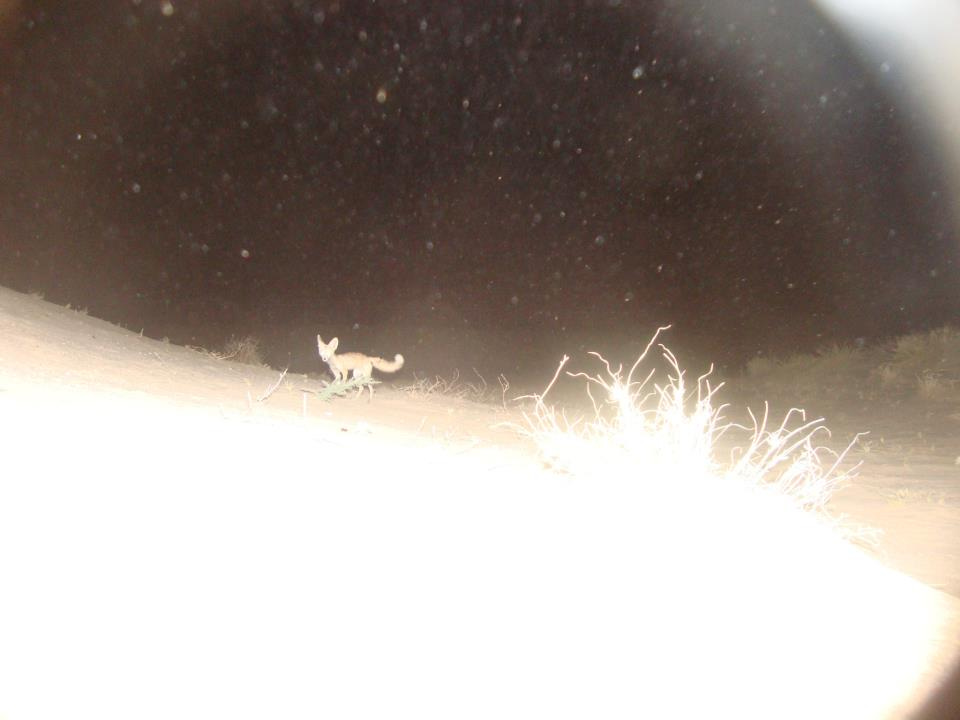
On Al Jaber Air Base in late 2004, the average night was at least cool, but cast with shadows made long and otherworldly by the flaring light of nearby towers of burning oil byproducts and the occasional pits of fire, making the land to the east look literally like hell; no better or worse than the fires of Mordor. But within the confines of the base, nature continued its struggle. Despite the general desertification of the country, the oil fields and military bases are ironically among the best preserved places, simply because they are fenced and restricted. Lands that are strewn with pipelines, drilling platforms, camps, industrial debris and the detritus of military engagement are among the most ecologically diverse areas in the nation. Ruppel’s foxes make their ghostly appearance, carefully emerging from their dens to see if the coast is clear. Hedgehogs and scorpions make their way from their subterranean homes to hunt and forage. Kangaroo mice are bountiful, and literally hop along the ground on their tiny little kangaroo legs. It was these mice, as much as anything, that led that desert’s mightiest predators into my life one night.


Not much more than a generation ago, the apex predator of the region could have been the Arabian Wolf or a Honey Badger or perhaps even a Striped Hyena, but by the time I arrived, these magnificent animals were no more than a ghost recorded in the depressing annals of regional extirpation. The apex predator of the day in 2004, as now, is the Desert Dog; not exactly a distinct species or even a recognized breed, but nonetheless a canine as adapted for life in the extremes of the desert as possible. Averaging around 40 pounds, they are small enough to be nimble, require proportionally less food, and regulate their temperatures more easily than their domesticated counterparts. They can dig dens as deep as 15 feet into the earth, and hunt lizards (including 1.5 foot Egyptian Spiny Tailed) and rodents.
2004 evokes a strange mixture of very strong and simultaneously very vague memories for me. It was busy and full of change and exploration, both geographical and emotional. I finished my Air Force enlistment in May of that year and completed a 7-week solo kayaking trap from Alaska to Seattle in June and July. Then I returned to my home town in Florida to help clean up after Hurricane Ivan, which left me fairly broke, so I took a one-year contracting job in Kuwait. It was familiar after a 2000 air force deployment, and I spent a lot of my first months exploring on the weekend in a little shared two-door Mitsubishi Pajero rental car, driving from border to border to border to sea and finding all of the dirt and sand tracks in between. I remember getting stuck in the sand fairly often and having random Kuwaiti strangers help me recover. I would later pay that forward 10-fold. My job at the time was to maintain a BAK12 aircraft arresting system, with around 11 other American contractors. The BAK12 is effectively a set of 2 B-52 Stratofortress strategic bomber brakes mounted on either side of a runway and attached to a cable stretched across the runway. The system is used for catching fighter jets experiencing some kind of emergency. We’d work 6, 12-hour shifts a week and drive about 45 minutes through oil fields and traffic back and forth every day. The work was boring, mostly because there was hardly any to do. We caught just a couple of aircraft the whole time I was there and did routine daily, weekly, monthly, and other periodic checks and maintenance. None of that took much time. Four of us became pretty close friends and spent our shifts together exploring, gardening (what we could…which was very little in the desert), and generally trying to stay busy for months on end. I spent increasing amounts of time catching different critters in the desert. A lot of the sequence of events is vague in my memory as I evolved from very bored to very busy, but I still remember tiny details like the clanking of our supervisor’s glass bowl, from which he noisily ate 100% of his near deafening meals while remaining utterly oblivious to how insane it made us all. In hind-sight, we should have just used hearing protection during meal times or maybe just talked to him about it. That would have made for a more peaceful working environment. And of course I remember Doughnut. A doughnut in our little desert world was a round rubber disc used to hold the arresting cable above the runway. An innocuous little piece of military equipment, but it was natural enough that when we found a litter of puppies in the base junkyard and I decided to adopt the little black runt, I dubbed her Doughnut.


Doughnut was the first dog I ever adopted, but I’m sure I took her from her mother too soon. My ignorant assessment was that, being half the size of her litter mates, she needed rescuing, and so I took her. I think I got lucky that she thrived physically. On the plus side, she received ample socialization at a critical period, and plenty of food. She turned out to be an incredible pet. However, I brought her into a life that really couldn’t accommodate a dog very well. For instance, not all of my coworkers were pro-dog, which was a real problem since I had to be at work more or less 14 hours a day and we all lived communally in a big walled villa. For me to keep Doughnut, I had to move outside the villa to what effectively would have been the servants quarters if we had had servants and I still had to constantly try to run interference between her and any potential issues that might arise with the less dog friendly residents. Fortunately for both me and Doughnut, my shift was the pro-dog shift. Still, there were issues. I owe my colleagues and management team a lot of gratitude for their forbearance, because I pushed and I pushed and I pushed against the limits of what was acceptable. Doughnut was wonderful, but she was a permanent flashpoint between shifts, and ultimately I decided (or maybe it was decided for me, another detail that escapes me), that she needed a more appropriate home. I used my mid-contract break to bring her to Missoula, Montana and to the ownership of a student I had met online through my own course work. My plan had been to attend the University of Montana full time when my contract was over, so I spent my break moving my limited possessions into storage in Montana and settling Doughnut into her new home. I would never see those possessions again. The villa and the shop felt empty when I got back to Kuwait, but it wouldn’t stay that way for long
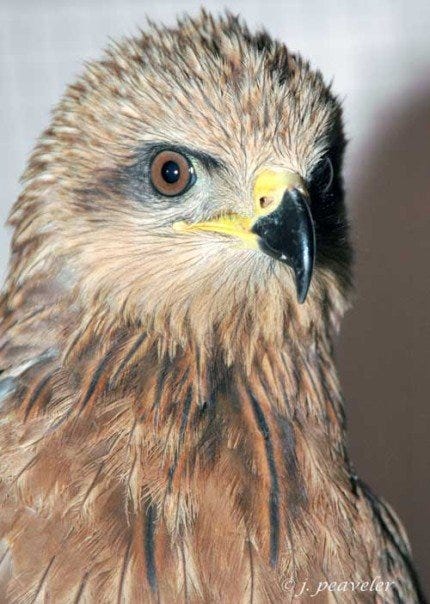
One winter weekend I was driving alone along the southern coast when I spotted a large bird trying in vain to fly but getting caught up in a hedge. Despite a deep ignorance of anything avian, I did what came naturally to me, and I somehow caught the bird. He needed help, so I decided to do what I could. Later, I would learn that so-called ‘hunters’ in Kuwait will pursue and shoot any kind of bird: eagles, vultures, flamingos, song birds, buzzards, hoopoes–anything at all and simply leave them dead or dying. I confronted one of them once, since by then I understood hunting to be illegal. He rather drunkenly showed me his police badge, and that was that. This particular bird was a European Buzzard. Doughnut’s care had been practically intuitive. A buzzard is a much more complicated creature, but I was committed, so I used our limited tools and built an inadequate buzzard cage. I wasn’t about to let ignorance stop me from doing this thing that seemed worth doing. I don’t quite remember how I got that cage assembled in my room at the villa. I’m sure my colleagues helped. Before long, I had quite a large European Buzzard living in a cage in my room. It was short sighted, to be sure. The housing was not adequate, the environment incorrect, and the diet all wrong. I couldn’t see anything wrong with this beautiful buzzard, so I tried to give enough time for recovery before taking him out to a safe area and releasing him. Perhaps it was just exhaustion afterall, but my last vision of that beautiful animal was the sight of wings flapping in the distance. It was a good, memorable feeling at the end of a steep learning curve.
The dogs that would totally change my life appeared suddenly out of the desert one day as twilight deepened the shadows and cooled the air. We were doing some routine maintenance by the runway, and they came to us as if some instinct told them we were the right sort of people. They stopped to say hello in their careful way, and I recall watching as one of the adults, a tan female we would come to call Sammy, stalked and pounced on kangaroo mice. She was a champion hunter. Years later, well into her retirement in Vermont, she would still jump straight up into the air to pounce on something in the ditch during her walks. Over time, they would visit us like we were neighbors, and I can remember exactly how each of them felt when I eventually touched them. Sammy’s coat was rough, coarser, not like a wire haired dog though; it was shorter but stiffer and spoke of a hard life, poor diet, and dehydration. Sylvester’s hair was softer, smoother, trending toward silky, not because her life was any easier, it wasn’t, but maybe just because of her genetics or perhaps she was eating different nutrients. Both girls were young, less than a year, but wizened by their life in the desert. Roscoe, on the other hand, was a pirate. He was a downright rascal, as salty and gnarly as a dog could be and still tolerate humans. He had significant scaring up and down his body, almost definitely from an encounter with a vehicle. He had survived what few dogs in that environment ever can, and he had the road burn scars to prove it. How he could possibly trust any human, ever, I can’t really know. He was aloof, and not strictly social, but if you moved slowly and respected his space, he would let you give him a few gentle pets on the side of the head. That boy was a survivor who would always go his own way. He was one of the oldest dogs I ever met in that desert. Desert dog life isn’t much different than a lot of wildlife: shortened by their adversities: in this case extreme heat, disease, resource availability, and intentional cruelty (hunting and vehicle strikes). I’d later discover that the average lifespan is less than a year and a half, and Roscoe had certainly lived longer than that. Each encounter with us left the impression that it was an honor for us to have been allowed to spend any time with him. Indeed it was.
They visited us off and on for a number of weeks or months, time really blurred out there, until the second most inevitable fact of dog life in the desert came to pass: not death, but life. Nature can be a cruel, hard thing, and it keeps pushing forward and making new life regardless of the consequences. The desert is even less forgiving on this principle. A female dog will almost certainly give birth in her first heat cycle, before she is even 1 year old. For Sylvester, that meant 5 puppies born in an abandoned barracks. Sammy was more trusting or perhaps just more fortunate or more intelligent. I’d like to think she was more sure that we would help her through a thing she was hardwired to do but ill-prepared to undertake. So it was that we returned to work one day to find her in a den under the shed behind our small office building, caring for 11 squiggling, moaning, squeaking and grunting puppies. When I think about that choice she made to not just trust us, but to rely upon us to help her through that process, it puts the entire sum of my career, from that moment to this one, into utter clarity. That dog undoubtedly changed my life more than any other.


Our workshop in a military contracting building was no kind of place to raise a pack of canine hooligans. There was no way they could stay around our workshop, not with the mix of pro- and anti-dog staff we had, but really it couldn’t last in the majority of workplaces. I didn’t blame anyone at all for their displacement, just the cruel fate that led to the predicament in the first place. I was still determined to do what I could. There was no shelter in the country, no government program other than poisoning dogs, and I wasn’t about to abandon those puppies to their fate, let alone their mothers who had given us so much trust. It was obvious to me what that fate would look like, so I did the thing that seemed like the next best thing among a set of bad choices. I moved them to a bigger and less frequently visited building on the other side of the base. It wasn’t exactly a long-term strategy, but it worked for a while at least. I took some old wire-mesh to block the bay door of an abandoned munitions warehouse, set up some big water buckets and moved moms and puppies in. Before long, I had 18 dogs, no plan, but as much hope as I could muster in the circumstances. I started spending a lot of my money on dog food, with support from the pro-dog faction. I really can’t remember now if I even got anyone vaccinated. I just remember feeling a powerful mix of overwhelm and hopelessness woven with puppy love and determination. I also can’t remember how long the situation lasted. It was weeks at minimum, perhaps a couple of months. The pendulum was about to swing, but for the first time since I got to Kuwait, it swung straight from problem to solution.
I arrived at work one morning to a summons to the office of the base commander, a Lieutenant Colonel in the Kuwaiti Air Force. He was a serious but polite man, as many officers are, and he was kind enough to listen to my explanation before rendering his decision regarding the fate of the dogs. He certainly had the power to take quite drastic action had he chosen, but he opted to give me 48 hours to get the dogs off his base. It was not unexpected, but it was nevertheless the realization of the thing I had been dreading these many weeks, and I was on borrowed time. By now all of the puppies of course had names and personalities. Casper, the white dog, I remember best, since by another twist of fate, she would end up spending the last few years of her adult life with my wife and I (she remained as feral as the day she was born). Other names have gotten jumbled in 20 years of animal rescue, but I remember how some would get out of the warehouse and I’d have to round them up and put them back in for feeding and water. I really did not know what to do with my eviction notice. There was no one to appeal to, so I did the only thing I could think of: I called the late, great Karen Orobey, who had helped me get an export permit for my first rescue dog. She had introduced me to a woman named Sarah Thorn, at whose house I had briefly met a woman named Ayeshah Al-Humaidi. I name them all here because they played really large roles in my life during this time and were vital forces for the work that would come next. Ayeshah, I had learned, was starting the first animal shelter in Kuwait. Karen connected me directly with Ayeshah, to whom I made my one possible appeal. I had two days, and nowhere for 18 dogs.


She didn’t hesitate. She’d just returned to her homeland after 6 years of school in the US, ready to build an animal welfare organization from the ground up, none of the pieces of which were really in place yet. She didn’t let that stop her. She just said okay, let’s come up with a plan. The shelter was already under construction, but no part of it would be ready for weeks at least. However, the shelter property had an old abandoned building with walls, a ceiling, but no windows or doors. It would have to do. She put me in touch with her brother Khalid, who, as he would many times in the coming years, dropped whatever more important thing he was doing to go with me to buy fencing supplies so we could fence some yard around the abandoned structure. This, along with the procurement of other care supplies, occupied our first 24 hours. Once that was done, we decided it could accommodate about half of the dogs, and the other half would go to their family home in Al-Surrah. This is rather a funny side story. The dogs went to the family home because both the matriarch and patriarch were away for the summer holiday. Dogs would soon occupy the bathrooms, dining room, and I don’t know where else. When one of them later dug a hole in the wall, it was covered with the generous gift of a new sideboard. Only years later would that piece of furniture be moved and the hole finally discovered.
The second 24 hours were spent actually moving the dogs. The geography of the area at that time is an important piece of the story. The shelter was being built in the farm lands that abut the Saudi border to the south, in a governorate called Al-Wafra. The family home was more or less in the city, about an hour and twenty minutes north. Meanwhile, the air base was about an hour from each location, including security gates and driving conditions. Imagine a triangle with one site on each point. The problem was that the roads connected the air base to the city but not to Wafra. The triangle was missing a line. Taking roads the whole way took about 2.5 hours from the base to the farm. A much faster, more direct route required an offroad excursion across open desert for about 45 minutes. I opted for the direct route. This first drive with 9 dogs was perhaps the worst of them all, since they were around 4 months old now and had never been in a car. Meanwhile, my experience of actual desert driving was still limited to mostly military vehicles and our light-weight rental. This was real desert driving, with small dunes, washboards, tan-outs (like a black out, but more tan), and dust, dust, and more dust. I quickly became quite adept at desert driving, although there would still be many lessons yet to come. So the first dogs arrived at the shelter site on the second day, and the second batch arrived in the city for their foster stay. Just like that, my time as a rescue dog tycoon on an old military base was over, but my career in animal rescue was just about to begin. With the sudden influx of 18 dogs, Animal Friends Kuwait, later re-named the Kuwait Society for the Protection of Animals and Their Habitat (K’S PATH) was born. But that is a story for another time.
Hi John, gosh so many memories flooding back at that crazy but fulfilling time of my life. It was all consuming, I often would head to the vets on auto pilot when I actually had one of my daughters in the car and should be heading to the Dr. There I met you and Ayeshah and life has not been the same since. Beautiful people xx